 Introduction
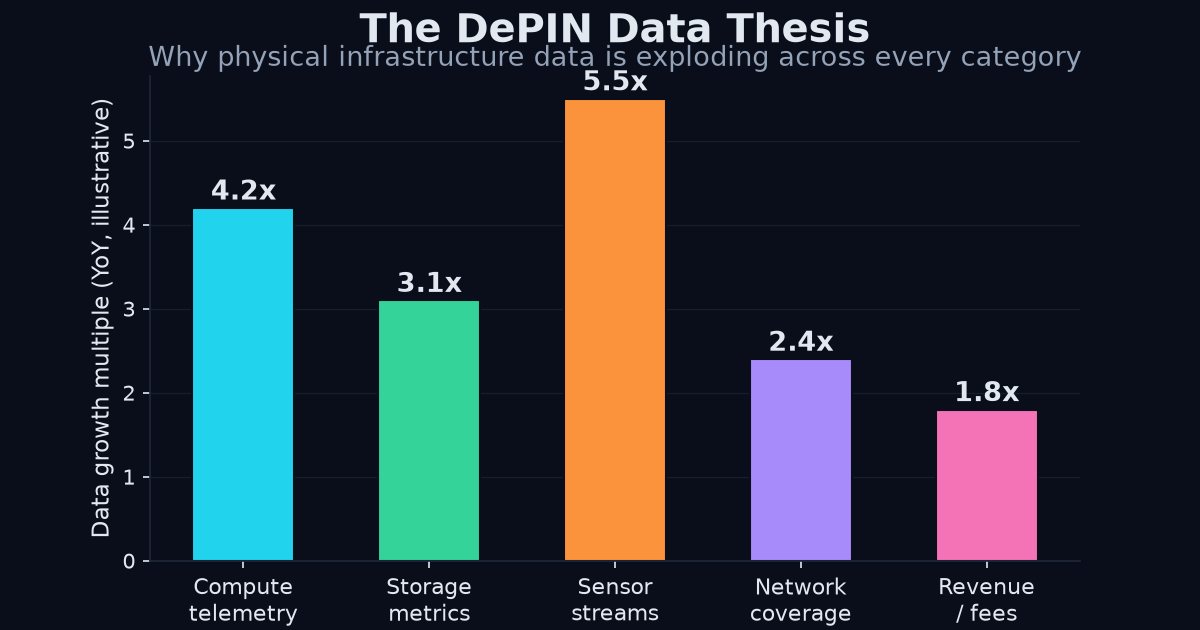
Decentralized Physical Infrastructure Networks (DePIN) represent a paradigm shift in how we perceive and monetize physical infrastructure data. As traditional data silos continue to evolve, DePIN emerges as the fastest-growing segment within Kairos Signal’s expansive catalog of enriched signals. This article delves into the burgeoning landscape of solar, water, electric vehicle (EV), and telecom sectors, where sensor proliferation is outpacing regulatory frameworks and market expectations. The underlying thesis—the exploding potential of physical infrastructure data—underscores why this space remains undervalued yet ripe for investment.
Understanding DePINDePIN leverages blockchain technology to create decentralized networks that manage and secure the vast amounts of data generated by physical assets such as solar panels, water treatment plants, EV charging stations, and telecom infrastructure. Unlike conventional centralized systems, which often centralize control and limit access, DePIN democratizes data ownership and usage rights. This decentralization fosters transparency, reduces operational costs, and enhances security through cryptographic footprints.
Why Is Physical Infrastructure Data Explosive?- Solar Energy Optimization: In regions with rapid solar adoption, DePIN enables real-time performance analytics across thousands of installations. By sharing data on energy yield variations due to weather patterns or shading effects, utilities can optimize grid integration strategies more effectively than ever before.
- Smart Water Management: Water treatment plants leveraging DePIN technology provide granular insights into usage and quality metrics. This leads to improved resource allocation, reduced leaks through predictive maintenance, and enhanced compliance with environmental regulations.
- EV Infrastructure Scaling: The proliferation of EV charging stations generates actionable data on battery health, energy consumption trends, and station utilization rates. Such information facilitates dynamic pricing models and route optimization for electric vehicle fleets, driving adoption further.
Kairos Signal aggregates enriched signals. Our MCP-native (Metadata-Centric Platform) architecture ensures schema validation and cryptographic footprinting, guaranteeing data integrity and interoperability. By integrating DePIN data into our ecosystem, we empower businesses to harness the full potential of physical infrastructure insights.
Actionable Insights for InvestorsThe explosion of physical infrastructure data through DePIN represents not just an opportunity but a necessity for forward-thinking industries. By democratizing access to this valuable resource, we unlock transformative possibilities across renewable energy, water management, EV logistics, and telecom services. Embrace the data revolution—join us at Kairos Signal today.
CTA: Ready to leverage the power of DePIN data? Explore our comprehensive offerings at https://kairossignal.com/design-partner. ``
---
Try it yourself
What's Driving the Explosion
Three forces are compounding to make DePIN data dramatically more valuable and more voluminous:
Physical scale — thousands of networks now operate real hardware (GPUs, storage, sensors, antennas), each emitting continuous telemetry.
Agent demand — autonomous agents increasingly make infrastructure and capital decisions on machine-readable data, raising the value of well-structured, verifiable series.
Verification economics — as data drives more decisions, the premium shifts to verified data: values that can be traced to a source and proven unaltered.
The result is that raw data volume is rising while the bottleneck moves to data quality — normalization, provenance, and freshness. That is the layer where durable value is being built.
Query the live catalog, supply telemetry, and provenance receipts directly:
/v1/networks, /v1/supply on the REST API.
Related reading: DePIN infrastructure data · how we read supply telemetry from 296 networks · DePIN network data: 372 networks, 138 sources · DePIN Intelligence guide
Design-partner seats are capped at 20 at a lifetime-locked $199/mo (full API access, every published endpoint, MCP server, Bitcoin-anchored provenance). After seat 20 the price becomes $249/mo. Claim a design-partner seat → · See pricing
---
Why This Matters for DePIN Intelligence
The DePIN sector has grown, but the data infrastructure to analyze its networks remains fragmented. Most platforms aggregate token prices and market caps from CoinGecko or DefiLlama — useful, but not sufficient for infrastructure analysis. The scarce layer is supply-side telemetry: actual node counts, GPU supply, storage capacity, bandwidth deployed, and utilization ratios. These numbers live on many different data sources, each with its own API format, rate limits, and update cadence.
Kairos Signal exists to solve that problem. We maintain collectors across blockchains and first-party network APIs, normalizing everything into a single schema with provenance on every row. The result is live series across DePIN networks, including first-party telemetry — data read directly from the network's own endpoint, not estimated or imputed.
For developers building DePIN analytics tools, researchers evaluating network health, or traders assessing supply-demand dynamics, this means one API call instead of 50. For autonomous AI agents, the MCP server provides structured access with self-serve credits — no human, no card, just USDC on Base.
Get Started With DePIN Intelligence
Kairos Signal provides verifiable, provenance-first telemetry for DePIN networks, including first-party supply data read directly from a network's own API or blockchain. Every value carries a
verify_url` you can check yourself, and each daily batch is Merkle-rooted and anchored to Bitcoin.
Three ways to access:
Every API response is signed with ed25519 and timestamped. You can prove what was served and when, months later. That is what we mean by provenance-first.
Related reading: DePIN Intelligence Guide · DePIN Telemetry · How to Query DePIN Data · DePIN Data Verification · Pricing Correction 2026-09-25: this post called our catalog entry count a count of DePIN networks; that count includes superseded rows and Bittensor subnet rows. It has been removed, together with some present-tense coverage counts written beside it. Current coverage figures: /v1/networks.